Introduction
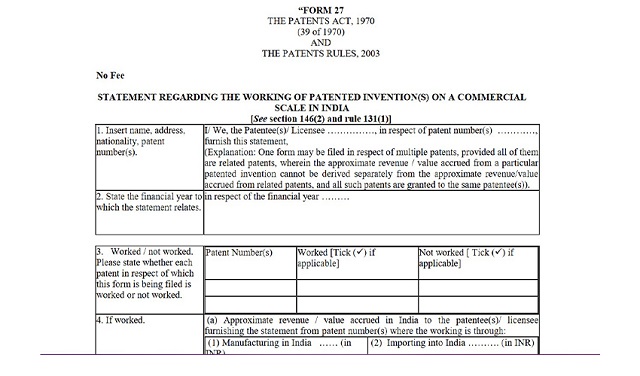
Filing the Statement of Working of Patents (Form 27) is a mandatory statutory compliance for patentees and licensees in India. The declaration ensures transparency on whether a patented invention is being commercially worked in India, aligning patent rights with public interest.
This article provides a step-by-step practical guide to filing Form 27 with the Indian Patent Office, explains legal requirements, deadlines, penalties, and includes FAQs and recent case law references to help patentees remain fully compliant.
What Is Statement of Working of Patents (Form 27)?
Under Section 146(2) of the Patents Act, 1970 read with Rule 131 of the Patents Rules, every patentee and licensee must periodically submit a statement declaring:
- Whether the patent has been worked in India
- The extent and nature of working
- Reasons for non-working, if applicable
The statement is filed using Form 27 before the Indian Patent Office (IPO).
Filing Frequency and Deadline (Updated Rules)
|
Requirement |
Details |
|
Filing Frequency |
Once every 3 financial years |
|
Applicable To |
Granted patents only |
|
Due Date |
Within 6 months from end of FY |
|
Typical Deadline |
30 September |
|
Government Fee |
Nil |
📌 Even non-working patents must be reported.
Who Must File Form 27?
- Individual patentees
- Companies holding granted patents
- Exclusive and non-exclusive licensees
- Indian as well as foreign patentees
Failure to file may have serious legal and commercial consequences.
Information Required Before Filing
Prepare the following in advance:
- Patent number
- Name(s) of patentee(s)
- Relevant 3-year financial block
- Working / non-working status
- Approximate revenue or value accrued in India
- Mode of working (manufactured/imported)
- Licensee details (if any)
- Reason for non-working
- Digital Signature Certificate (DSC)
Step-by-Step Procedure to File Form 27 with IPO
Step 1: Access IPO E-Filing Portal
Visit the Comprehensive e-Filing System of the Indian Patent Office.
Step 2: Log In Using Registered Credentials
Ensure:
- Your account is active
- DSC is registered and mapped
Step 3: Select Filing Category
Navigate to:
Patents → Miscellaneous Filings → Form 27 (Statement of Working)
Step 4: Enter Patent Details
- Patent number
- Applicant/patentee name
- Title of invention (auto-filled)
Step 5: Select Financial Year Block
Choose the relevant 3-year period (e.g., FY 2021–22 to FY 2023–24).
Step 6: Declare Working Status
Select one:
- ✔ Patent worked in India
- ✘ Patent not worked in India
Step 7: Provide Working Details (If Worked)
- Brief description of working
- Approximate revenue/value accrued in India
- Manufacturing/import information
📌 Detailed sales figures are not mandatory.
Step 8: Provide Non-Working Reasons (If Not Worked)
Examples:
- Regulatory approvals pending
- Market constraints
- Technology under development
- Strategic business reasons
Step 9: Declare Licensing Details
- Whether licenses/sub-licenses exist
- Names of licensees (if applicable)
Step 10: Review, Digitally Sign & Submit
- Review auto-generated Form 27
- Sign using Class III DSC
- Submit and download acknowledgment
✅ No government fee is payable
Penalties for Non-Filing of Form 27
Non-compliance may lead to:
- Monetary penalties under the Patents Act
- Adverse inference in compulsory licensing proceedings
- Weak position in patent enforcement or litigation
- Negative impact during due diligence or investment rounds
Best-Practice Tips from Patent Professionals
- Always file Form 27, even for dormant patents
- Use clear and concise language
- Avoid confidential commercial disclosures
- Maintain internal evidence supporting declarations
- Track compliance dates for large patent portfolios
FAQs – Statement of Working of Patents (Form 27)
1. Is Form 27 mandatory for all patents?
Yes, it is mandatory for all granted patents, irrespective of whether they are worked or not.
2. Is there any government fee for filing Form 27?
No. Form 27 is filed free of cost.
3. Can Form 27 be filed for multiple patents together?
No. Each patent requires a separate Form 27 filing.
4. Do foreign patentees need to file Form 27?
Yes. Foreign patentees holding Indian patents must comply.
5. What if the patent is not commercially used?
You must still file Form 27 and state valid reasons for non-working.
6. Is exact revenue disclosure required?
No. Only approximate value accrued in India is required.
7. Who can sign Form 27?
- Patentee
- Authorized signatory
- Registered patent agent
8. Can incorrect filing cause legal issues?
Yes. False or misleading statements may attract penalties and weaken patent rights.
Important Case Law on Statement of Working of Patents
Ericsson v. Controller of Patents (Delhi High Court)
The court emphasized the importance of Form 27 disclosures and clarified that patentees must make good-faith declarations regarding working of patents.
Shamnad Basheer v. Union of India
This landmark PIL led to reform of Form 27, reducing disclosure burden while reinforcing the principle that patents must serve public interest.
Natco Pharma v. Bayer Corporation (Compulsory Licensing Case)
Non-working of patents and inadequate Form 27 disclosures played a key role in the grant of India’s first compulsory license.
Why Compliance with Form 27 Matters
- Strengthens patent enforceability
- Protects against compulsory licensing risks
- Demonstrates responsible patent ownership
- Enhances credibility during audits and litigation
Need Professional Help?
At AdroIP, we assist clients with:
- Form 27 compliance & portfolio management
- Patent prosecution and enforcement
- Indian & international patent filings
📩 Contact us at www.adroip.com for expert IP support.